Launch readiness · 26 Aug 2026
Human-led · fixed $750 · 24–48 hours
Before real users find what the demo hid, I do.
A production-readiness audit for AI-built apps. I review the critical journey, permissions, payments, deployment and mobile behavior—then give you a plain-English verdict: ship, remediate or rebuild.
No mandatory sales callRead-only access where possibleClient-owned code and accounts
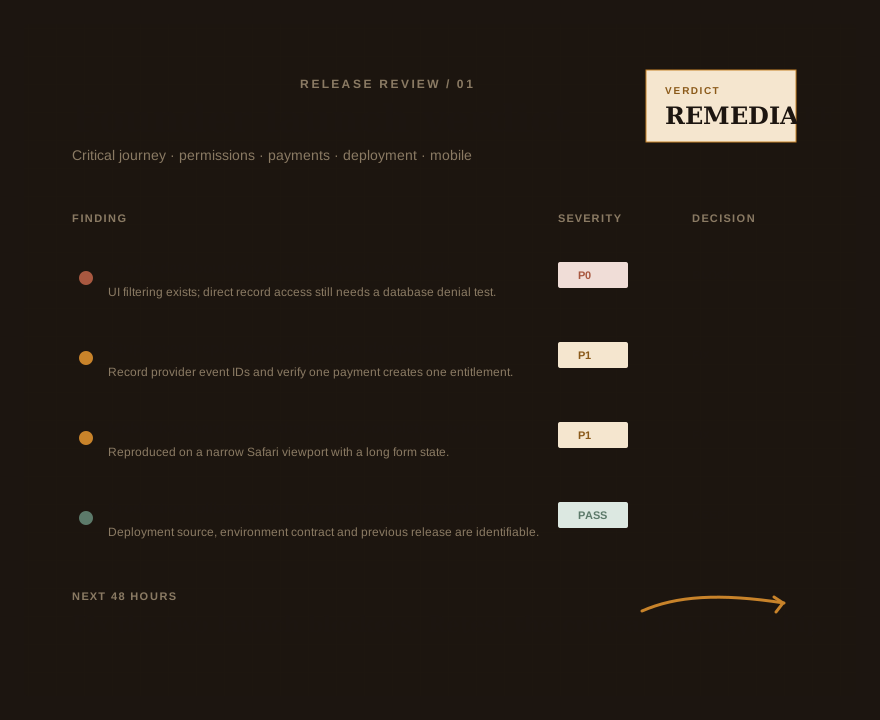
The founder moment
The app looks finished. Your confidence does not.
You have moved faster than a conventional team could. Now a real user, payment or deadline is about to turn hidden assumptions into public consequences.
“You do not need more code. You need an independent decision.”
01
The happy path works. The failure path is unknown.
The demo completes with your account and your data, but retries, expired sessions, duplicate actions and incomplete states have not been forced.
02
Authentication exists. Authorization is still assumed.
Users can log in, but tenant isolation, role boundaries, storage access and server-side ownership have not been proved with the wrong account.
03
Stripe redirects successfully. Revenue state may still be fragile.
A browser success page is not evidence that signed webhooks, event replay, refunds and entitlement creation are deterministic.
04
The deadline is commercial, not technical.
A customer, investor, pilot, App Store review or public launch is approaching. You need to know what matters now—not add another feature.
Not a surface scan
The public website is only one layer of the product.
Not generic code review
The audit follows the commercial journey and its failure states.
Not a scare report
Findings are bounded by evidence and explicit limitations.
A launch decision
Risk is translated into what the founder should do next.
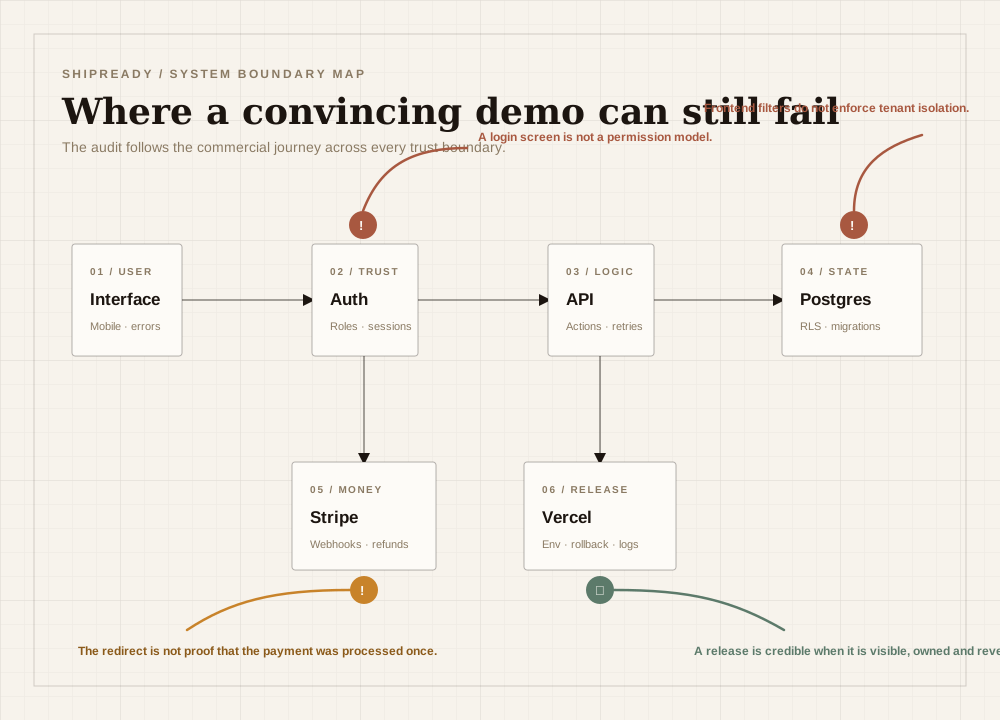
What gets reviewed
The entire path between the user’s intention and the business outcome.
01
Critical user journey
The one commercial path that cannot fail, tested through success, interruption, retry, duplicate action and recovery.
02
Identity and permissions
Authentication, roles, tenant isolation, privileged routes, server checks, storage access and service-role boundaries.
03
Data and Supabase
Schema constraints, RLS, migrations, ownership, deletion behavior, functions, auditability and recovery assumptions.
04
Payments and entitlements
Checkout, raw-body signature verification, amount validation, idempotency, refunds and one-payment-to-one-outcome conversion.
05
Deployment and operations
Environment separation, secret handling, production source, monitoring, failed jobs, account ownership and rollback.
06
Mobile and interface quality
Real-device behavior, keyboards, safe areas, touch targets, sticky controls, loading, empty and error states.
07
Maintainability and handoff
Whether the next feature can be added without destabilizing identity, data, payments or the client-owned codebase.
Security-relevant controls are reviewed within this product scope. Formal penetration testing, certification and regulatory assessment remain separate specialist services.
The deliverable
A report designed to produce action, not anxiety.
Every material issue is connected to evidence, user impact and a decision. The result is concise enough for a founder and specific enough for an engineer or coding agent to execute.
A plain-English ship, remediate or rebuild verdict
P0, P1 and P2 findings ranked by user and commercial risk
Evidence for every material finding and limitation
A sequenced remediation plan your agent or engineer can execute
A fixed follow-on scope where implementation is commercially sensible
A concise founder walkthrough without technical theatre
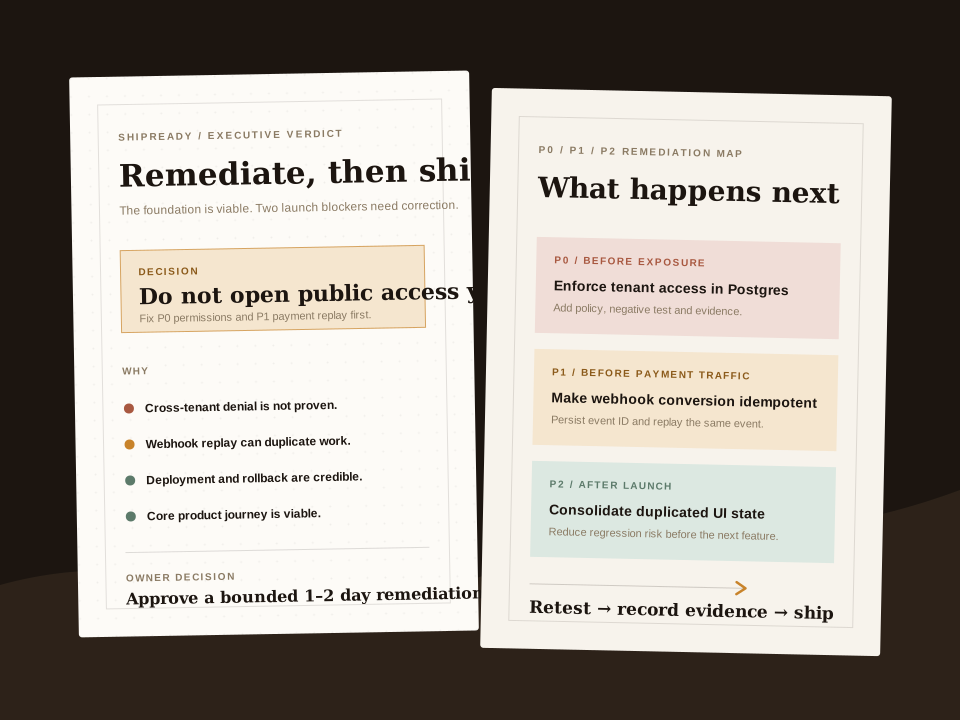
A bounded process
From “is this actually ready?” to a defensible answer.
01
Fit
Send the URL, stack, target date and the one journey that cannot fail.
02
Access
Grant read-only repository and provider access where the scope requires it.
03
Audit
I force the critical path through code, data, payment, deployment and device boundaries.
04
Decision
Receive the verdict, ranked evidence and the smallest credible next scope.
The 24–48 hour target begins when the agreed access and context are complete. No password or raw secret should be sent by email or chat.
Strong fit
Use ShipReady when the product is about to become real.
You built with AI and need an independent reviewer before launch.
A paid pilot, customer, investor or App Store deadline is approaching.
The product uses Supabase, Stripe, Vercel or similar managed infrastructure.
You need a ranked decision rather than an open-ended engineering engagement.
Use another specialist
The audit is intentionally not everything.
Formal penetration testing or security certification
Legal, regulatory or compliance opinions
Unlimited feature work or an open-ended rebuild
A guarantee of App Store or third-party approval
Claims about systems or code that were not available for review
Why Liam
Built by a product operator, not an anonymous audit factory.
I build and operate products across web, mobile, subscriptions, private platforms and AI workflows. The review is shaped by what breaks launches, support, payments and client trust—not by which scanner can produce the longest PDF.
See the operating proofFour
live iOS subscription products shipped and operated
EN + AR
product delivery across English and Arabic user experiences
Full stack
Next.js, Supabase, Postgres, Vercel, Stripe and App Store workflows
Client-owned
repositories, infrastructure, accounts and maintainable handoff
Common questions
What you should know before granting access.
The scope is explicit so you can decide quickly without a staged sales process.
What is the ShipReady Audit?
ShipReady is a fixed-scope production-readiness review for AI-built web and mobile products. It follows the critical journey across permissions, data, payments, deployment and mobile behavior, then gives the founder a ship, remediate or rebuild verdict.
Who is it for?
It is designed for founders and product owners who built quickly with Cursor, Claude, Lovable, Bolt, v0, Replit or a similar workflow and are approaching a real launch, paid pilot, investor review, App Store submission or client handoff.
What access do you need?
Start with the product URL, stack, target date and critical journey. Read-only repository and relevant infrastructure access are preferred where possible. Passwords should never be sent; access should be granted through the provider’s own invitation and least-privilege controls.
Is this a security audit?
Security-relevant controls such as authentication, authorization, RLS, secrets, storage and webhooks are reviewed within the production scope. ShipReady is not a formal penetration test, certification or regulatory assessment.
How quickly is it delivered?
The normal target is 24–48 hours after the required access and product context are available. A blocked environment, incomplete access or a materially larger system can change the timeline before work begins.
Does the $750 include implementation?
No. The audit includes the verdict, evidence and remediation plan. The full $750 can be credited against a qualifying fixed remediation sprint booked within seven days.
Can I start without a call?
Yes. Send the URL, stack, target date and critical journey. A call is used only when the product context cannot be captured safely in writing.
Will you tell me to rebuild everything because AI wrote it?
No. Generated code is judged by behavior, boundaries and change risk. The objective is to preserve the speed that created the product while fixing only what is genuinely unsafe or commercially fragile.
Read before you ship
Production guidance written for founders, not search engines.
Read
Founder guide · 26 Aug 2026
Prototype vs Production: What Changes After the AI Demo Works
Supabase security · 26 Aug 2026
Supabase RLS Mistakes AI-Built Apps Commonly Miss
ShipReady Audit
Put a clear decision between the demo and the launch.
Fixed $750 scope. No mandatory call. Full fee credited against a qualifying remediation sprint booked within seven days.